
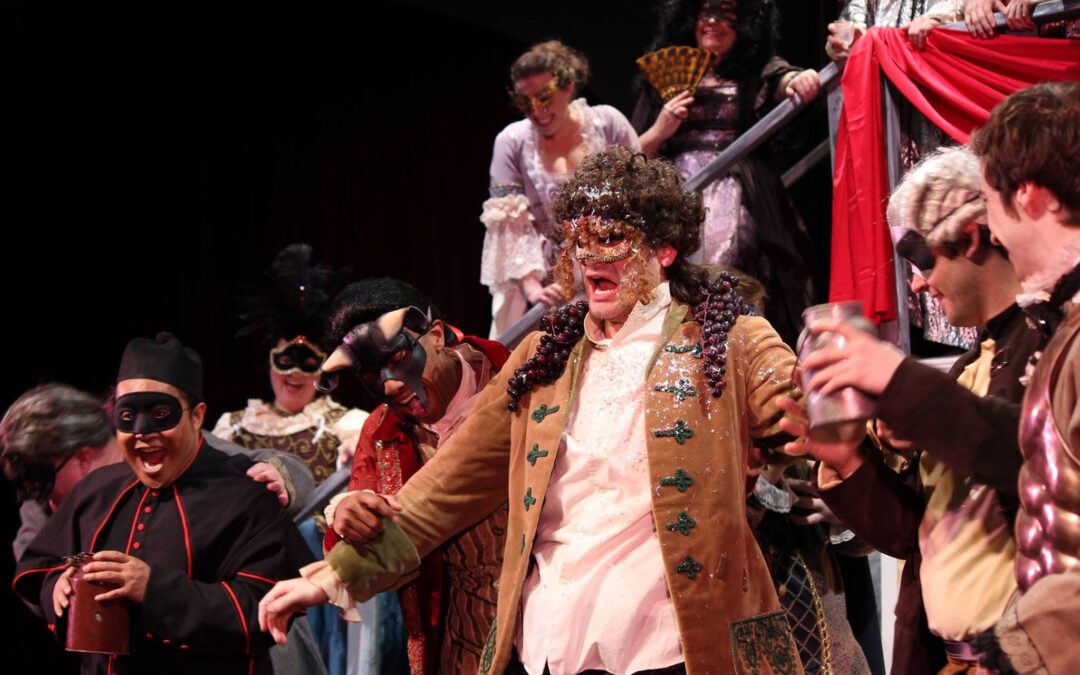
In 2014, I found myself waist-deep in fabric bolts, Danish dictionaries, and Enlightenment philosophy. We were preparing the Chicago premiere of Maskarade, Carl Nielsen’s effervescent comedy and the Danish national opera. The project grew from a Danish cultural grant I’d helped secure for VOX 3 Collective — but it became something larger: a full festival of music and masquerade, a dialogue between centuries, and a living reminder of why art flourishes most when it crosses borders.
The Idea
Maskarade (1906) was Nielsen’s attempt to reclaim laughter for Danish opera. His source was Ludvig Holberg’s 1724 play Mascarade, a social satire celebrating equality, disguise, and joy. Holberg, Denmark’s Enlightenment playwright, believed that comedy could reform society better than sermons. Nielsen’s score took that conviction and set it to music — blending folk tunes with courtly arias, parodying opera itself while honoring it.
When I first proposed the project, few people in Chicago had heard of the piece. Even fewer had sung a word of Danish. But the story — of a father who forbids his son to attend masked balls, only to discover that disguise frees people to see one another clearly — felt universal. With support from the Chicago Community Trust and our partners at the Swedish American Museum and Danish Pioneer, we decided to stage Maskarade as the centerpiece of a broader festival: Music & Masquerades, exploring four hundred years of Danish art and sound.
The Festival
The festival ranged from 17th-century Baroque sacred works — Pedersøn, Buxtehude, Telemann’s lone Danish cantata — to 19th-century Scandinavian art songs by Grieg, Sibelius, and the often-overlooked Danish masters. Each concert was paired with lectures, dinners, and book discussions. The idea was to recreate the texture of a culture rather than a single concert season — to let audiences taste, hear, and converse their way through Denmark’s musical past.
Children’s programs at local libraries introduced Hans Christian Andersen stories and folk songs, while Kierkegaard’s Fear and Trembling brought philosophers and musicians to the same table. The project culminated in a dinner event, The Sounds of Scandinavia, at the Swedish American Museum, where music, language, and conversation intertwined over smørrebrød and aquavit.
The Opera
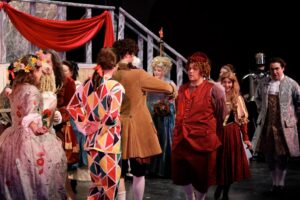
But Maskarade remained the heart of it all. Mounted at the Vittum Theater, it involved a cast of thirty, an orchestra of twenty-four, and an untranslatable amount of men’s tailoring — most of which, by some twist of fate, I handled myself. Every cuff and waistcoat seemed to mirror the opera’s duality: refined artifice and honest laughter.
Learning Danish was its own adventure. For weeks, the rehearsal room buzzed with the guttural Rs and soft Ds that make the language sound like “Swedish with mashed potatoes in your mouth,” as one cast member joked. Yet once inside Nielsen’s vocal writing, the sounds began to make sense. His rhythms taught us the language as much as any diction coach.
Our singers came to love the humor and humanity of the score. We rehearsed for months in the basement of a Ravenswood church, learning the diction, playing with the characters, just enjoying each other’s company, always with the sense that we were doing something fun and slightly crazy. Nielsen’s characters are recognizably flawed, exuberant, and hopeful — Enlightenment everymen who want to live freely and love boldly. The audience’s laughter confirmed it: even those who couldn’t understand a word of Danish understood everything essential.
The Impact
More than 700 people attended the opera and its companion concerts. For many, it was their first exposure to Danish language or culture. Members of Chicago’s Danish community were visibly moved to hear Americans singing their native tongue with care and conviction. Critics, too, responded warmly: Chicago Classical Review called Maskarade the city’s “Most Ambitious Opera Production” of 2014, while WFMT’s Andrew Patner described our VOX 3 Collective as “the best of serious independent artists.”
But what mattered most to me was the spirit in the room — the collective act of discovery. Maskarade was written about equality at a masquerade; our production enacted it. Performers built sets, volunteers sewed costumes, and audiences met us eye to eye. It was, in a way, the realization of everything storefront opera means: art returned to the people, not distant but shared.