
 I disappeared for a while because I was living on the only inpatient child and youth psychiatric ward in Saxony that would take a child our son’s age.
That is the factual version. The emotional version is harder to phrase without sounding dramatic, and I have no interest in that. What I can say is that the place itself has become, for us, almost synonymous with futility.
We were there for about a month. One of us was with him around the clock. From the beginning, we were told they needed time to observe. They could not yet diagnose, could not meaningfully adjust medication, could only watch and document. Since we were already living in a state of close observation—and since it became clear early on that what we were seeing was not being taken in with much precision—we began writing our own daily reports.
Those notes now read like a second chart no one used.
What I remember first is not theory but texture. Locked doors. Alarms. Children screaming until their voices gave out, then starting again. Six-, seven-, eight-year-olds breaking things, plugging toilets, hurling language they had clearly learned there. Whole units tipping into lockdown because one child’s dysregulation spread through the room.
Christmas was there.
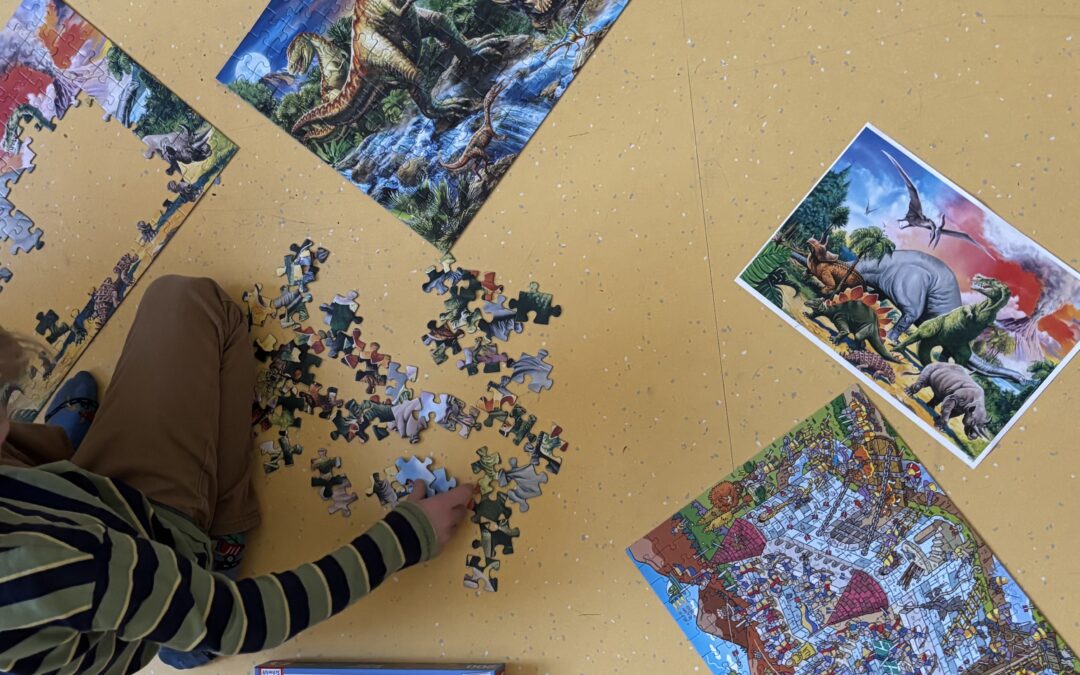
And in between, long stretches of repetition. Puzzles, again and again. The same pieces, the same motions, as if the brain were trying to rebuild itself through pattern. The same audiobook on loop: Michel aus Lönneberga, that stubborn, inventive boy who gets everything wrong and somehow still makes his way back. I held onto that more than I expected.
The staff said they were watching.
So were we.
And what we saw was not random. Our son was most vulnerable at transitions—especially the shift from a calm one-to-one setting into something socially or sensorily dense. Hunger and delayed medication could derail an entire morning. Waiting could push him past the point of return. A small disappointment could destabilize hours.
In the right conditions, though, something else appeared. With enough structure, enough closeness, and enough real cognitive challenge, he could build, read, puzzle, write, imagine—sustain focus far beyond what the ward seemed to expect. In those moments, he was not a mystery. He was a child whose system needed a very particular balance to hold.
Our reports showed the same patterns, day after day. In groups, he unraveled quickly. In one-to-one settings, with meaningful engagement, he regulated. Underchallenged, he escalated. Overstimulated, he escalated. Given something that met him at the right level, he could stay.
From where we sat, this did not look like a problem of “attachment.”
We said that early and often. Attachment was the wrong tree. Whatever else was happening, this was not best explained by distance or a failure of bond. Closeness, structure, shared activity—those were often the only things that worked. But once that idea had taken hold, it seemed to pull everything back to it. The interpretation didn’t shift; the observations were bent to fit it.
That was the hardest part. Not just that we disagreed, but that the disagreement changed the frame. The parent who was holding the situation together became, in the institutional story, part of the problem.
And yet the reality on the ward didn’t fully support that story either. Individual nurses would say, quietly, that we didn’t really belong there. That he was picking up the worst from the others. That this wasn’t helping in the way it should. Small comments, never official, but enough to make the disconnect impossible to ignore.
Our reports became more detailed over time, not to argue, but to record. Mornings lost to the impossibility of eating when hungry but unable to act on it. Public moments where he became unsafe and unreachable, followed by stretches of calm in contained environments. Careful, thoughtful work undone in an instant. Long periods in our room, not as withdrawal, but as the only place where stimulation could be balanced well enough for him to succeed. Evenings where five minutes of waiting tipped everything over. Car rides that became precarious. Calm restored, improbably, by story.
None of it was neat. But it was not invisible.
By late December it was clear to us that the stay was drifting into something we had not agreed to: extended observation without traction, a framework we believed was wrong hardening in place, and no real movement on the treatment path we had repeatedly asked to pursue. I had the sense they were imagining a much longer stay. We were not.
So on December 23, we asked for discharge.
What it felt like was leaving in a hurry, with the strange sense that we were doing something improper by taking our own child out of a system that wasn’t helping him. That feeling—of having to justify reclaiming your own ground—has stayed with me.
Later, an Arztbrief arrived.
It said almost nothing. No meaningful insight, no clear shift. One medication was gone—no more guanfacine. But the atomoxetine we had explicitly asked to move forward on was still not in place. In its own way, that was the most accurate summary of the month: a guardrail removed, nothing built.
When we came home, we were careful.
We put the knives away. We kept things simple. Puzzles and Michel weren’t enrichment anymore—they were scaffolding. Ways to mark time while something deeper tried to settle.
And then, slowly, something shifted.
The rebound was not clean, but it was real. In the clinic we had watched deterioration. At home, even through exhaustion and constant vigilance, it felt like a family again. Like progress was possible. My father came to help for a while—he saw it too. He arrived worried and left having witnessed moments of real joy. Sitting together watching Ice Age. Small things, but unmistakable.
And still, we are not back where we were.
Months later, the break is still visible. He can’t yet spend more than ten minutes in a classroom. A tram ride in the morning can be too much. The system reset, but not fully. Whatever gave way there is still rebuilding.
He was six. None of this is who he is. It’s what he moved through.
I used to judge parents more than I should have. I had ideas about what I would never become—how much of myself I would keep separate, how I would manage, where the limits would be.
Those ideas did not survive contact with reality.
What I know now is simpler. Every parent is carrying more than you can see. Most of the time, love looks unremarkable. It looks like repetition. One more puzzle. One more story. One more transition managed. One more meal coaxed through. Staying close enough that a child can borrow your nervous system when his own is gone.
We came back without a clean answer. No single explanation that ties everything together. But with something steadier: a clearer sense of what helps him, a sharper instinct for when something is off, and less patience for systems that confuse watching with seeing.
He is still himself. Bright, intense, curious, sometimes overwhelming, often wonderful. And I am still learning how to meet him there.
So…That’s where I was.