
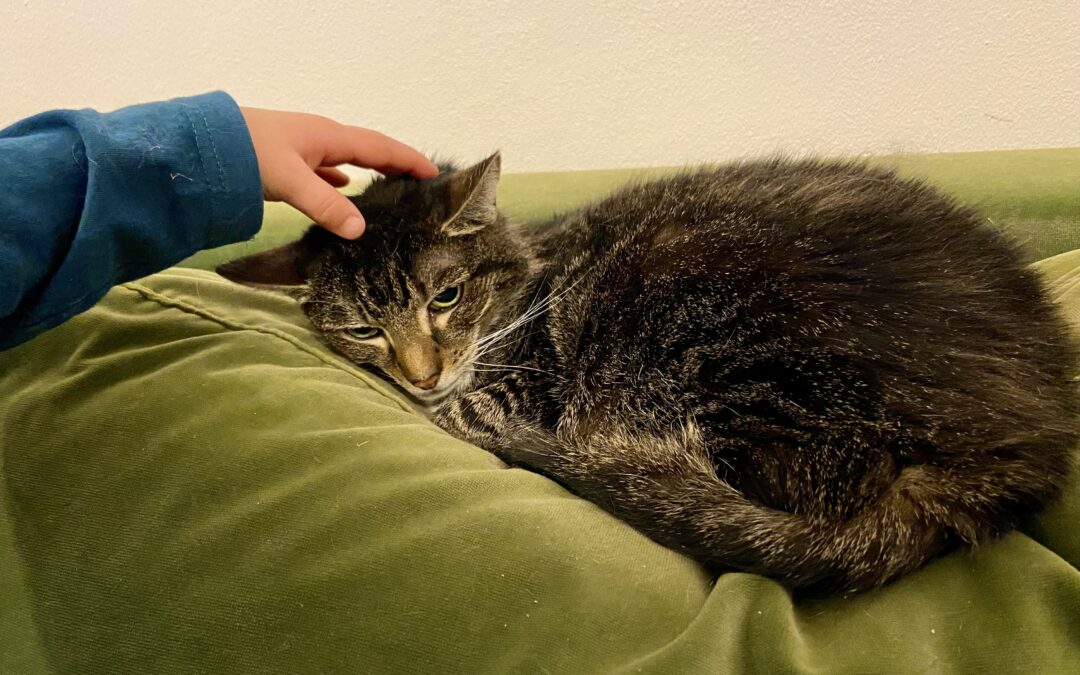
LG carries her to school now—not the cat herself, of course, but a stuffed likeness of her, held in his arms with a kind of care that didn’t exist when she was actually here. He tells me she’s with him. I don’t correct him.
When she was alive, she kept to the soft edges of the house. Windowsills, a green sofa that matched her Disney-Princess eyes, the same patch of sun that moved across the floor each afternoon. LG was the opposite—fast, loud, curious, always in motion. He loved her, but in the way kids sometimes do: hands first, understanding later. He chased her, grabbed too quickly, didn’t read the signs. We stepped in, explained, tried to slow things down. Sometimes it worked. Often it didn’t.
When she died, we tried to do what you’re supposed to do. We got the books. The Tenth Good Thing About Barney. The Memory Tree. Gentle, thoughtful stories about loss, about memory, about how something remains. We read them together before we went out to the garden.
We brought her with us. LG helped dig the hole. We read a poem. We planted a Perpetua et Felicitas climbing rose above her—something living, something that would grow where she was.
And then, at some point, he saw her. Really saw her. The body, stiff with cold. The teeth, just visible. It wasn’t what the books had prepared him for.
He had nightmares after that.
Life is messy.
Now he talks about her as if she had always been gentle, always close, always his. She walks with him. She listens. She waits. He tells me what she likes, what she thinks, what she would say. He’s built a version of her that fits the kind of care he’s learned since she died.
It’s hard not to notice the difference.
At the same time, I’ve been trying to finish a story about her.
In Perpetua’s Window, she becomes Miss P—composed, patient, a quiet teacher. The child learns to watch, to touch gently, to stop when the tail says stop. When she grows old and disappears, the loss is there, but it’s held. The child understands enough to carry her forward.
It’s a good story.
But it isn’t quite the one we lived.
I keep circling that gap when I revise it. If I smooth it too much, it feels false. If I lean into what was actually hard—the grabbing, the stress, the moments where we didn’t get it right—it starts to sound like a lesson, and I don’t trust that either. I’m not trying to teach anyone anything. I’m just trying to tell it in a way that feels honest.
Meanwhile, LG isn’t struggling with tone or structure. He’s just doing something simple: he’s remaking her. He’s spent more time building who she is now than he ever did when she was alive. And in that version, he knows how to be with her. He carries her carefully. He checks on her. He talks to her like she matters in a way he couldn’t quite manage before.
It came too late for her.
But not too late for him.
That’s the part I keep coming back to—not as a lesson, just as something I can’t ignore. Kids don’t start out knowing how to handle something fragile. They figure it out slowly, and sometimes they only really get there after something’s gone. It’s not clean, and it’s not fair, but it’s real.
Writing this story has felt similar. I kept thinking I needed to land it—to make it resolve, to make it say something clear. But the more I work on it, the more it feels like that’s not the job. The job is just to hold both versions—the one we lived and the one he’s carrying now—without pretending they match.
He still takes her with him every morning.
He adjusts his arms like she might slip. He asks me to wait if he needs a moment. He checks on her.
The care is real.
I’m still figuring out how to write that.