
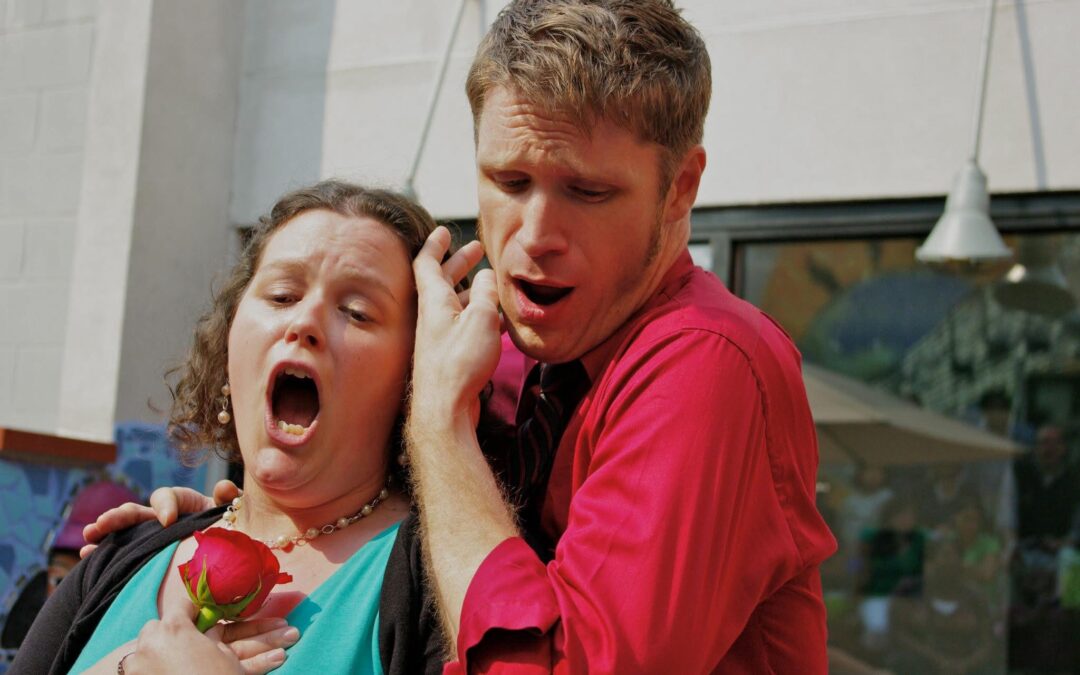
Opera didn’t begin in gilded theaters. In the early seventeenth century, Jacopo Peri’s Euridice and Monteverdi’s Orfeo were written for small court audiences—dukes and scholars gathered in candlelit chambers, listening to stories brought to life through music. Heinrich Schütz’s Dafne, composed in Torgau in 1627, followed the same path: courtly entertainment, yes, but up close and profoundly human. The first operas were, in essence, elegant house concerts—the sound of conversation made art.
That intimacy was what I longed for centuries later in Chicago—a city full of musicians, thinkers, and humanities-minded colleagues who could sing and think deeply at once. We built a community around that ideal: to see what would happen if opera were stripped of its velvet curtains and returned to conversation.
Our dream was to make that early spirit visible again—to return music to its neighborhood roots, to rooms small enough that the walls could vibrate with the singers. We wanted programming that was smart, the effect authentic and immediate, the connection electric.
Sendak in Skokie
 One of my favorite projects was Brundibár—Hans Krása’s children’s opera, written in 1938 and later performed by young inmates at the Terezín concentration camp. We staged it in collaboration with the Skokie Public Library as part of a celebration of Maurice Sendak’s work. Sendak had illustrated a picture-book version of Brundibár with Tony Kushner, turning a story of defiance and imagination into a bridge between generations.
The program included Chicken Soup with Rice (Carole King and Sendak’s “Really Rosie”), scenes from Oliver Knussen’s Where the Wild Things Are and Higglety Pigglety Pop!, and finally Brundibár itself. Children from the community danced and sat onstage with us, listening to the story unfold at arm’s length.
Brundibár is a parable about standing up to tyranny: two children whose music defeats a bullying organ grinder who tries to silence them. It’s about the courage to speak, even when the world tells you not to—and about the power of collective voice.
What struck me most wasn’t the story’s darkness, but the way storytelling made it bearable. Hearing an opera should be as natural and accessible as a parent reading a story to a child. In Skokie, it felt that way. The proximity dissolved intimidation; the music became part of everyday empathy.
Rediscovering the Forgotten
Another afternoon, the same library became a stage for long-forgotten German composers. Under the title From Weber to Wagner: German Opera in the 1830s, we explored the “missing link” between Mozart’s wit and Wagner’s ambition—the world of Lortzing, Marschner, Spohr, and Nicolai.
Without an orchestra pit to separate us, the audience leaned forward. They could hear the laughter that Offenbach would later refine and the yearning that Wagner would magnify to mythic scale. The concert led to further collaborations with DANK Haus, Chicago’s German-American Cultural Center, where we continued to explore cultural history as living dialogue—not museum piece.
Dinner, Strindberg, and a Single Voice
Speaking of cultural centers: one of the most vivid evenings we created was at the Swedish American Museum, devoted to the playwright August Strindberg. The centerpiece was Hugo Weisgall’s The Stronger—a taut modern monodrama for soprano and piano—paired with the world premiere of a new song cycle by composer Elizabeth Rudolph (available here on YouTube).
Sara Salas’s performance was astonishing. Her character’s unraveling happened within arm’s reach, the sound physically inhabiting the space. You could see people in the audience leaning in, not out. Some who might have been turned off by the music alone empathized with the characters because it was so close. The rehearsal process had been as theatrical as the show itself; we did character work more typical of „straight theater“ than opera; we built meaning together by calling up real emotion, not hiding behind style.
What Remains
Looking back, those projects weren’t just about rediscovering repertoire. They were about rediscovering relationship. People don’t come to art for spectacle; they come to be reminded of connection.
Opera is often accused of being elitist, but its origin is the opposite—a communal act meant to make myth feel human again. In a small room, the power dynamic shifts: the singer stops performing for the audience and starts communicating with them.
That’s the quiet stage I carry with me now, whether I’m directing, writing, or simply listening. The lesson of those storefront years was that beauty doesn’t require distance. Sometimes the most profound sound is the one shared across a single breath of air.